

If I see one more Coco Chanel quote about being chic or Parisian or minimal or glamorous or super-feminine or what-evaaa I may just blow a gasket. Because it turns out that Coco was a piece of WORK, and not in the da Vinci, “oh she’s a Mona Lisa” sense.
Whatever your feelings about tweed, pantsuits, and Karl Lagerfeld, we need to make a distinction between Coco the woman and Chanel the brand – although as we’ll see, you can only tease them apart so much.
Coco Chanel and the Brand Story
Chanel as a brand is synonymous with French luxury and with the liberation of women’s workwear, although the liberation of which women’s workwear is an important factor in the whole “Chanel as a bastion of feminism” idea that fashion people love to espouse. The Chanel woman is wealthy, entrepreneurial, vaguely sensual, self-assured, and loves tweed.
Lots and lots of money and confidence and tweed.
Coco Chanel as a person is widely seen to represent the ethos of Chanel as a fashion house. She went from orphanhood to creator one of the world’s largest and most influential fashion houses, popularized pants for women (I mean, wealthy white women), and made the tan popular (for wealthy white women).
Chanel’s website goes through great pains to drive home the vision of Coco as a free-spirited, avant-garde revolutionary, which certainly has some element of truth.
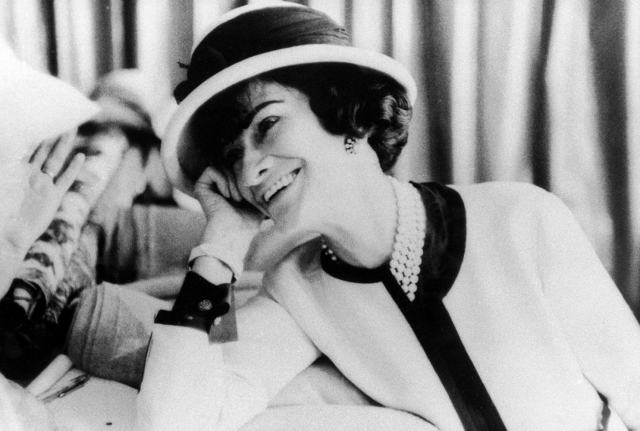
The Other Side of Coco
But there’s another side to Coco that I can’t reconcile with, that makes my thoughts stutter as I try to understand that the brand continues to elevate her and her life as the cornerstone of its identity.
Y’all, Coco was a bigot.
Not in the “but everyone back then was a bigot” kind of way.
She was homophobic, elitist, and a Nazi.
Not like a soup Nazi.
Like, an actual Nazi.
God Bless the Good People of TikTok
To be completely transparent, I was blissfully ignorant of Coco Chanel’s … leanings … until I posted the Dolce & Gabbana on TikTok and people asked me when I would do a video about Coco. I said, “soon!” and quickly did a Google search on why one might need to put her on blast.
The good people of TikTok did not lead me astray – what I found was, frankly, shocking. I wasn’t surprised in the least that a white woman of means living in France in the first half of the twentieth century was bigoted; no, I was surprised and disappointed that the brand Chanel continues to put Coco on a freaking pedestal. The fact that we live in such a polarized world where hate crimes of every variety are on the rise makes this marketing move inconceivable to me.
Video: The Dirt on Coco Chanel
The marketing on the Chanel website is a flawlessly produced feat of willful ignorance – you’ll see what I mean if you watch the video I’m posting below, then see their page dedicated to Coco. They say of their founder, “Gabrielle Chanel lived her life as she alone intended. The trials of a childhood as an orphan and the successes of an accomplished businesswoman gave birth to an extraordinary character; daring, free, and ahead of her time.” No mention anywhere of her deep and lasting involvement in the Third Reich.
I’m posting the new TikTok video on Coco Chanel below, which summarizes the dirt historians have uncovered on her life in the past few years, as the French government has declassified World War II-era documents.
@stigmendes Because Coco was the WORST: TW: anti-semitism, homophobia #chaneltiktok #chanel #cocochanel #dolceandgabbana #tiktokfashion #millennialsoftiktok
Let’s not forget that Coco’s support for the Nazis had real, tragic consequences for real people. Real families were destroyed, and it was recent enough that I even have friends whose families are still picking up the pieces after the Holocaust. So this isn’t just her naughty “dark side,” as I’ve seen reported. It’s real, and it’s ugly in the deepest, most disturbing sense of the word.
I’m not necessarily advocating that anyone “cancel” Chanel (although I personally can’t stomach reviewing the brand anymore). I get that cancel culture can be problematic and sometimes aggravates the problem. I also get that the brand is a juggernaut in fashion for a reason, as it has historically represented the freedom and right to self-determination for (some) women and arguably used fashion to advance those ideals.
For me, though, the question remains: which women were Coco, and now the brand, trying to liberate? My gut tells me that it isn’t women of color, or disadvantaged women, but women like Coco.
And why would I ever want to be like Coco?
love,
Stig
Sources and More Reading
The New York Times, “Was Coco Chanel a Nazi Agent?”
The Washington Post’s book review, “‘Sleeping with the Enemy’, by Hal Vaughan” (you can find the book here)
Alma, “Yes, Let’s Keep Reminding People that Coco Chanel was a Nazi Supporter”


